
Safeguarding
Safeguarding is everyone's responsibility
Alcester Grammar School is committed to safeguarding and promoting the welfare of children and young people. It is our expectation that all staff, volunteers and members of the school community share this commitment.
Safeguarding is not only about child protection, it includes early identification of problems and work to improve them or prevent them from becoming worse. It involves concerns including but not limited to emotional wellbeing, online safety, peer relationships, exploitation, domestic abuse and support for families.
What happens when I raise a concern?
Your concerns will be listened to and taken seriously. A trained member of staff will support you and ensure your worries are followed up proportionately, including through school based pastoral support, Early Support or referral to external agencies where necessary. Our aim is to work with you and empower you to improve the situation.
Signs and symptoms a young person needs support:
Common things friends and parents tend to notice include: changes in mood, attendance, friendships, online activity, eating or sleeping, behaviour, mood or self-esteem. If you have a nagging doubt, it is better to talk to us so we are aware we can keep a watchful eye. You do not need to be certain before sharing a concern. If something does not feel right, please speak to us.
Meet the team:
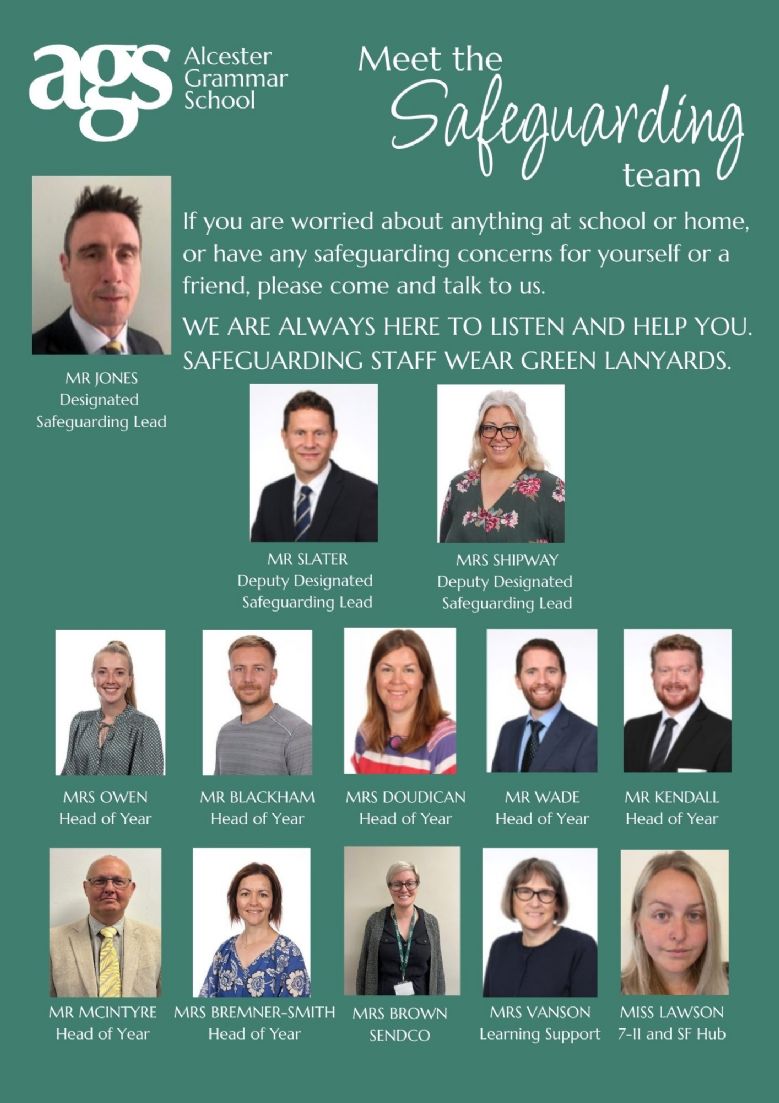
| Designated Safeguarding Lead - Andrew Jones | dsl@alcestergs.com |
| Deputy Safeguarding Leads - Jeremy Slater and Clair Shipway | dsl@alcestergs.com |
| Safeguarding Governor - Kyri Mitsiou-Begg | k.mitsiou-begg@alcestergs.com |
| Prevent Lead - Andrew Jones | dsl@alcestergs.com |
| Attendance Lead - Stewart Walker | s.walker@alcestergs.com |
| Senior Mental Health Lead - Clair Shipway | dsl@alcestergs.com |
I am a child, and I don't feel safe:
If you are at school:
1.Tell a trusted adult. This could be your Tutor, Pastoral Team or a teacher
2.Ask to speak to a member of the Safeguarding Team
At home or in the community:
1. Call and speak to an adult at school on 01789 762494
2. Use the community reporting tool (monitored during term-time school hours)
3. Email dsl@alcestergs.com (please note this email is monitored during term-time school hours)
4. Phone Childline on 0800 11 11 any time, day or night. They are happy to speak to you about any worries. The call is free.
If you feel you or another child is in immediate danger, please call 999
I am an adult and am concerned about a child:
If you are concerned about a child, you can do one of these things:
1. Report it to the School's Designated Safeguarding Lead (DSL) by phoning the school on 01789 762 494 or emailing dsl@alcestergs.com (please note this email is monitored during term-time school hours)
2. Contact your local children's services:
Warwickshire
01926 414144 – Monday to Thursday 8.30am – 5.30pm and Friday 8.30am-5pm
01926 886922 – Out of hours and at weekends
https://www.safeguardingwarwickshire.co.uk/safeguarding-children/
Worcestershire
01905 822666 – Monday to Friday 9am – 5pm
01905 768020 – Out of hours and at weekends
https://www.safeguardingworcestershire.org.uk/home/wscp/
For all other sources of support and information, please click here.
Our full Safeguarding policy can be found here.
In an emergency, please call 999
Online Safety
At AGS we aim to equip our students with the knowledge, understanding and skills to use information and communication technology creatively and purposefully. A key aspect of this lies in being digitally literate. Online technologies play a huge role and so providing a broad and balanced Online Safety education is vital to ensuring that students can navigate the online world safely and positively.
- Please click here to view the online safety curriculum map.
- 'What I wish my parents or carers knew' - a guide for parents and carers on managing children's digital lives.
Removing a nude image shared online
It can be frightening finding out a nude image of you has been shared online. Please see the guide linked below to get your image removed from the internet.
Childline - get your image removed
Prevent
Prevent is about protecting children and communities from extremist views and the threat of terrorism. As with all safeguarding it is important not to be complacent, but also not to panic.
Incidents of extremism and radicalisation are rare and as such when they do occur, make the news. As with all safeguarding issues, it is important to be vigilant, and not complacent, but also not to panic.
What is extremism and radicalisation?
Prevent defines extremism as: “vocal or active opposition to fundamental British values, including democracy, the rule of law, individual liberty and mutual respect and tolerance of different faiths and beliefs. We also include in our definition of extremism calls for the death of members of our armed forces”
Radicalisation is defined by the UK Government within this context as “the process by which a person comes to support terrorism and extremist ideologies associated with terrorist groups.”
However…
We live in a wonderfully diverse world, with both differences and similarities to celebrate. Exploring religious and different social beliefs, in a peaceful and non-violent way, is part of growing up and should not be confused with something more sinister. The best way to PREVENT extremism and radicalisation is by open discussion and increased understanding of each other.
As a parent…
You know your child better than anybody else. Having open, honest conversations on a regular basis will allow your child to explore new ideas in a safe environment.
Talk to your child about their online viewing. Social media such as YouTube, Facebook, Twitter and Instagram can be used to groom children towards a certain point of view.
Discuss different points of view concerns topics in the news, modelling that there is always more than one point of view.
Encourage your child to take an active part in their local community. This could be part of a sports club, social group, volunteering. Getting out, meeting and talking to people around you helps to understand and become part of a community.
Some useful links:
Support to understand radicalisation and extremism
Parents’ Resources – Educate Against Hate
As a school…
- All staff have had Prevent training from an accredited Prevent trainer in school.
- All staff have completed further online Prevent training
- We have updated our safeguarding procedures to reflect statutory requirements in the Government’s Counter-Terrorism and Security Act 2015.
- We have direct contact with the Local Prevent Officer and other external professionals to receive on-going support and two-way communication.
- Students are encouraged to discuss and explore issues during tutor time, assemblies and on safety days.
If you have any concerns that someone you know may be at risk of radicalisation, please contact the local police on 101.
If your concern is of an URGENT nature, please dial 999 or the Anti-Terrorist Hotline 0800 789 321
Exploitation
Sexual Exploitation
Sexual exploitation can take many forms from the seemingly ‘consensual’ relationship where sex is exchanged for attention/affection, accommodation or gifts, to serious organised crime and child trafficking. What marks out exploitation is an imbalance of power within the relationship. The perpetrator always holds some kind of power over the victim, increasing the dependence of the victim as the exploitative relationship develops.
Sexual exploitation results in children and young people suffering harm, which can cause significant damage to their physical and mental health. Whilst some children can be supported to make a recovery, others may suffer serious life-long impairments which may, on occasion, lead to their death.
Any child or young person can be a victim of sexual exploitation, but children are believed to be at greater risk of being sexually exploited if they:
- Are homeless
- Have feelings of low self-esteem
- Have had a recent bereavement or loss
- Are in care
- Are a young carer
However, there are many more ways that a child may be vulnerable to sexual exploitation and the signs that a child is being exploited are not easy to spot.
Signs of Grooming and Sexual Exploitation:
Signs of child sexual exploitation include the child or young person:
- Going missing for periods of time or regularly returning home late
- Skipping school or being disruptive in class
- Appearing with unexplained gifts or possessions that can't be accounted for
- Experiencing health problems that may indicate a sexually transmitted disease
- Having mood swings and changes in temperament
- Using drugs and/or alcohol
- Displaying inappropriate sexualised behaviour, such as over-familiarity with strangers, dressing in a sexualised manner or sending sexualised images by mobile phone (“sexting”)
- They may also show signs of unexplained physical harm, such as bruising and cigarette burns
Child Criminal Exploitation (CCE)
Child Criminal Exploitation (CCE) is where an individual or group takes advantage of an imbalance of power to coerce, control, manipulate or deceive a child into any criminal activity (a) in exchange for something the victim needs or wants, and/or (b) for the financial or other advantage of the perpetrator or facilitator and/or (c) through violence or the threat of violence. The victim may have been criminally exploited even if the activity appears consensual. CCE does not always involve physical contact; it can also occur through the use of technology.
Children and young people may be vulnerable to neglect and abuse or exploitation from within their family and from individuals they come across in their day-to-day lives. These threats can take a variety of different forms, including: sexual, physical and emotional abuse; neglect; exploitation by criminal gangs and organised crime groups; trafficking; online abuse; sexual exploitation and the influences of extremism leading to radicalisation.
CCE can include children being forced to work in cannabis factories, being coerced into moving drugs or money across the country (county lines), forced to shoplift or pickpocket, or to threaten other young people.
Signs of possible CCE include:
Signs of child criminal exploitation include the child or young person:
- Persistently going missing from school or home and / or being found out of area
- Unexplained acquisition of money, clothes, or mobile phones
- Excessive receipt of texts / phone calls
- Relationships with controlling / older individuals or groups
- Leaving home / care without explanation
- Suspicion of physical assault / unexplained injuries
- Carrying weapons
- Significant decline in school results / performance
- Gang association or isolation from peers or social networks
- Self-harm or significant changes in emotional wellbeing
Please speak to a member of the safeguarding team for further information or advice.
Sexualised Behaviours
Significant guidance from the DfE:Sexual Violence and sexual harassment between children in schools and colleges. Our continuum tool will help you and your child understand the level of the issue they have been exposed to. All students have had experience of using the tool themselves to better understand and report things they feel uncomfortable with.
Reporting any concerns as a parent/carer:
If you have any concerns that your child has been the victim of sexual violence or harassment, please speak to your child’s pastoral team.
Students reporting concerns:
If a student wants to disclose anything of this nature, they can talk to any member of staff. All of whom have been trained in how to respond to a disclosure.
The pastoral and safeguarding teams will then respond appropriately, potentially involving outside agencies e.g. the police and social care.
We are able to signpost specialist agencies who can support our students and their families following a disclosure.
Domestic Abuse
If you or someone you know has experienced domestic abuse, help is available:
- If you feel unsafe call 999 and ask for the police
- If you cannot use a voice phone you can text REGISTER to 999 and you will receive a text message which tells you what to do next
- Refuge can be called for free 24 hours a day on 0808 200 0247
- National LGBT+ Domestic Abuse Helpline – 0800 999 5428 (run by Galop)
- Women’s Aid offer information and support via a live chat which can be accessed via their website
- The Forced Marriage Unit can be contacted on 020 7008 0151
- The National Stalking Helpline can be called on 0808 802 0300 (run by Suzy Lamplugh Trust)
- Respect provide an advice line for male victims of domestic abuse it can be called on 0808 8010327
- Respect also offers a helpline for people who are worried they may be perpetrating domestic violence it can be called on 0808 802 4040
Training
Everyone who comes into contact with children and their families has a role to play in safeguarding children. School staff receive regular training to help them to identify concerns at an early stage. They report any concerns through MyConcern, an electronic child protection management system that automatically alerts the Designated Safeguarding Lead and the Deputy Designated Safeguarding Leads and action is taken immediately.
Annual safeguarding training includes:
- Safeguarding awareness for every member of staff and Governors to include basic awareness, CSE, FGM/HBV, racist/homophobic and transgender bullying
- Annual CLF online Safeguarding training for all staff and Governors
- Channel/Prevent online course for all members of staff and Governors
- MyConcern training for all staff
- Regular safeguarding updates through staff briefings and inset days e.g. on sexualised behaviours
- Safeguarding Assembly for students
- E-Safety assembly for students
- Prevent assembly for students
- Safety Days are responsive to local safeguarding need
Wider Safeguarding System
School staff fall within the wider safeguarding system for children and we work with Social Care, local health services, Police, YOT and many other services to promote the welfare of our students and young people and to protect them from harm.
Early Support
Early Support is the help offered to potentially vulnerable children, young people and their families. Early support is designed to prevent problems escalating. All children, young people and families are entitled to receive Early Support. If you live outside Warwickshire, Early Support might be called Early Help. They are the same process.
Early Support is a voluntary process where we will work with children and their families to coordinate support to solve and/or prevent issues from escalating. To initiate Early Support, we will complete an assessment with you to understand need and discuss possible avenues of support. We will then meet with you every 6–8 weeks to review the plan and the support. If there are siblings or other family members who attend different schools, we may invite them to contribute and update the assessment and plan.
Early support can help with issues such as attendance, behaviour, emotional wellbeing, family pressure, online safety, relationships, bereavement, financial hardship or changes at home.
More details can be found on the relevant local authority website for the area in which you live:
If you are experiencing money worries, please reach out to us. More information can be found on our Financial Support Page
Please contact a trusted member of staff. This could be your child's Head of Year or any member of the safeguarding team.